
Sector:
Civil Engineering
Expertise:
Jacking
Skidding
Benefits:
Parallel operations
Optimized schedule
Record breaker
Location:
United States
Installation technique minimizes disruption for road-going public.
When replacing an old bridge with new, time is always a critical factor - especially if the crossing serves as a main route in and out of a busy city.
The original Pittsburgh Commercial Street bridge went into construction in 1948 and was completed in 1951. Today, it is used by more than 100,000 vehicles every day.
The concrete bridge went through three rehabilitations in its life, during 1980, 2006 and 2012 - but eventually needed to be replaced with a new structure that could carry permit loads.
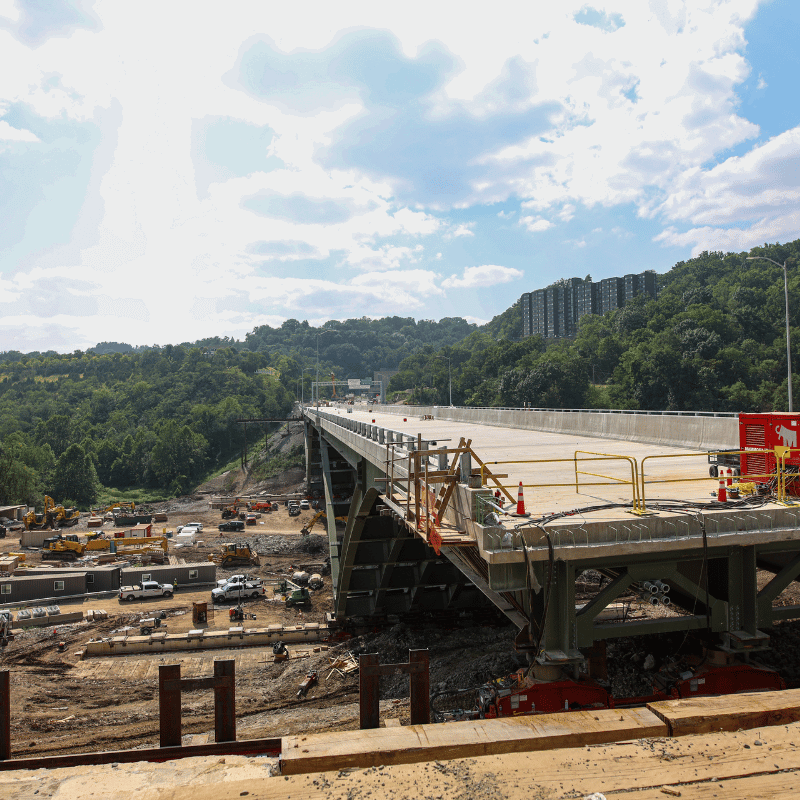
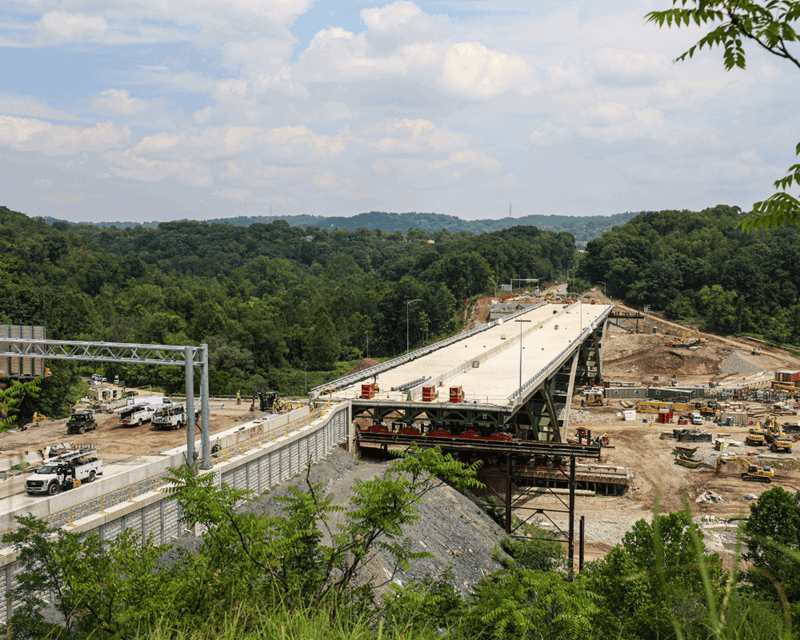
This major infrastructure project utilized Accelerated Bridge Construction (ABC) techniques. The replacement span was built beside the old bridge over a period of months, and then laterally slid into position immediately after the old bridge was demolished.
This methodology reduced the time of traffic impacts on the public, from nearly four years of intermittent lane restrictions and closures via traditional bridge construction methods to just 17 days of a continuous around the clock closure. It also meant the old bridge could remain open until the very last moment, minimizing disruptions for the public.

Mammoet played a significant part in making all this possible, combining its heavy-lift experience with specialist skidding equipment that was used to install the Chernobyl New Safe Containment structure in 2016.
Appropriate shoes for the occasion
The new steel arched delta frame bridge was assembled just meters away from the old one. Only intermittent lane closures had to happen to enable site preparations.
Mammoet worked with Fay, S&B USA Construction, the prime contractor responsible for building the new bridge and the demolition of the old bridge, which included conventional demolition methods and a controlled implosion. Mammoet’s scope was to plan, manage and perform the skidding installation of the new 10,000t bridge once the old structure and all debris were removed.
“We moved the entire bridge structure whole – the deck and the main support structures”, explains Mark Lane, Engineering Team Lead at Mammoet. “Our skidding system allowed for this type of solution to be feasible and provided the quickest means of replacing the bridge”.
The low height and high load capacity of the system are the key reasons it was chosen. Most skidding systems are likely to move laterally a little when they pick up a heavy load. However, this system can resist that transverse force and minimize stresses on the lifted load.
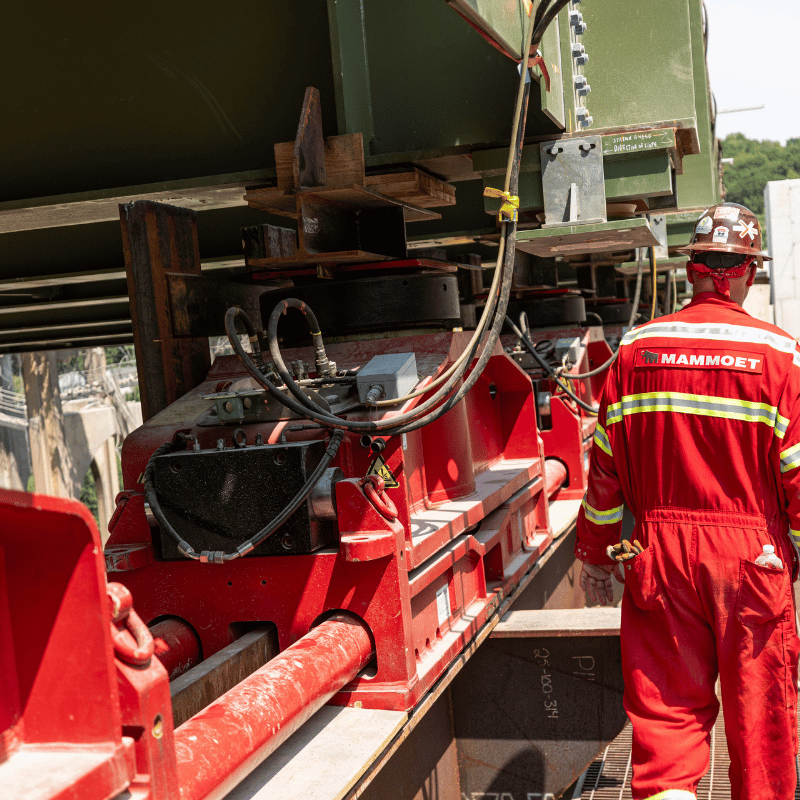
To provide additional protection against twisting forces, a temporary frame was erected between the bridge and the skid shoes, securing everything in place. The low height of the skid shoes gave the engineering team more room to make this frame strong enough without needing to make its foundations wider.
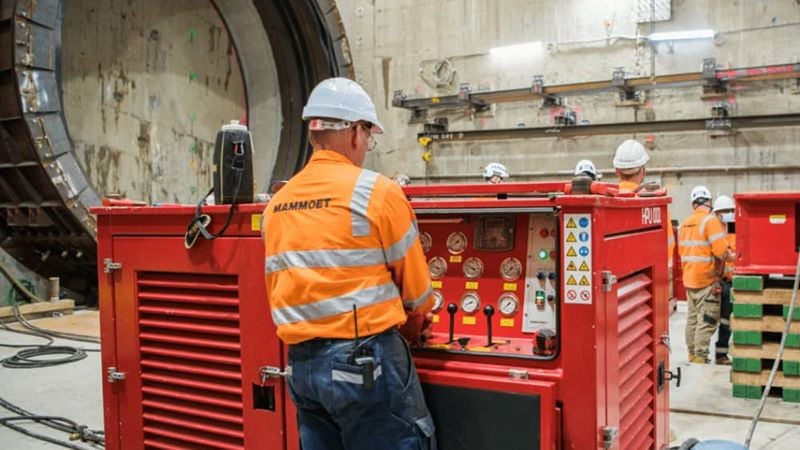
The skidding system also has a newly revamped control system to give operators unprecedented precision and oversight – from the stroke of the main cylinder to the skidding force. Each skid shoe can be operated independently, with the integrated hydraulic jack being used to lift the load from its temporary construction supports and set it down on its permanent bearings.
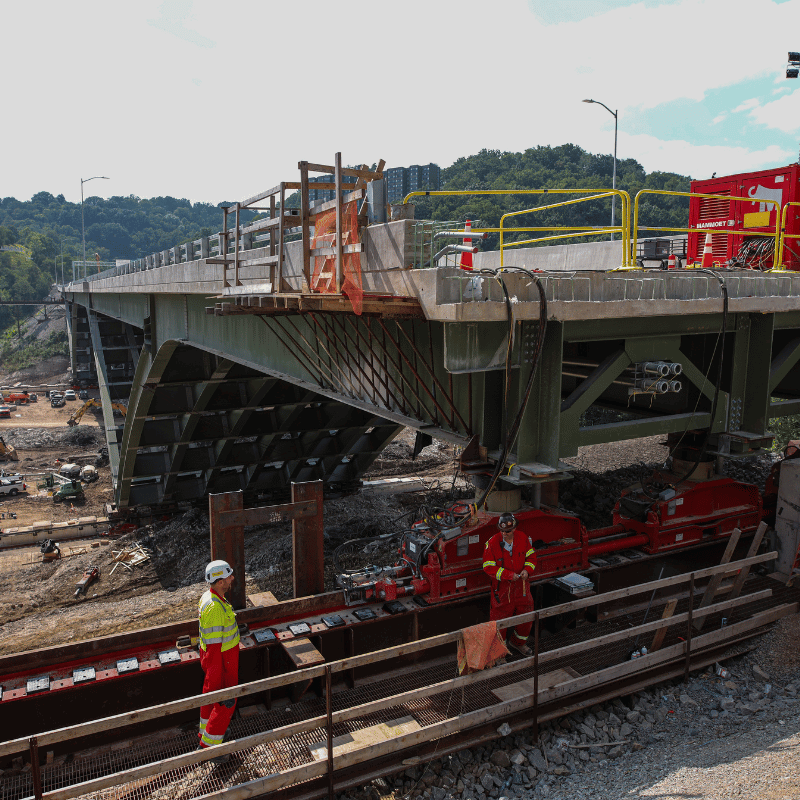
A total of 42 skid shoes were used for the installation. The shoes were spread over four primary support runs: two at the bridge piers and one at each of the abutments.
The team needed to ensure every section of the bridge moved at the exact same time, with only a one-inch tolerance from pier to abutment available (2.5cm). They conducted a test slide to pick up and move the bridge five feet (1.5m) forward, checking deflections and ensuring everything behaved as normal before the final slide.
The final skidding distance was 102ft (31.1m), which was performed in one continuous move. This was achieved in a single day shift.
Instant bridge installs
While other skidding solutions could have been considered, this would have presented different challenges when it came to the height of the shoes and the control of the system.
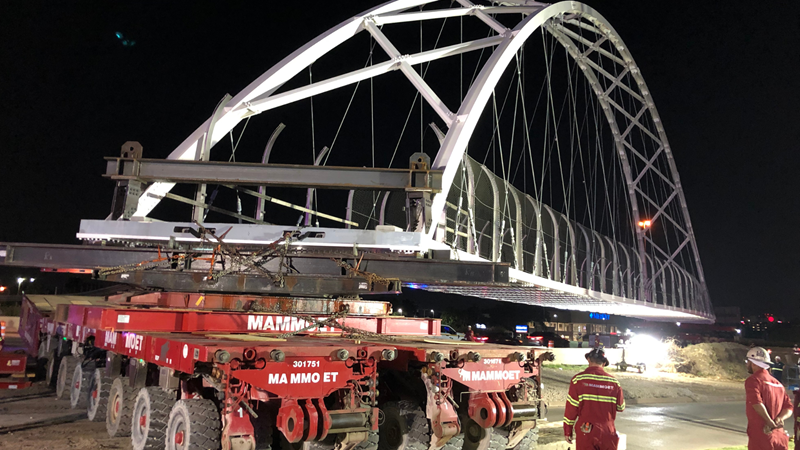
Mammoet Self-Propelled Modular Transporters (SPMTs) have also been used to perform similar jobs, but there would have been challenges with the limited space on the construction site.
To date, this marks the heaviest bridge that Mammoet has moved in the US. The operation was made possible in such a short time using a skidding system unlike any other in the world.
“It has been a true global effort from our side to make this project happen. We’ve involved multiple offices and departments,” closes Lane.
“I think the scale of bringing a system of this capability and size to bear on a US project is good. We are now looking at utilizing this system on several other projects now that it is in the US”.