Sector:
Case study
Civil Engineering
Expertise:
Jacking
Heavy transport
Benefits:
Reduced disruption
Optimized schedule
Increased safety
Location:
Germany
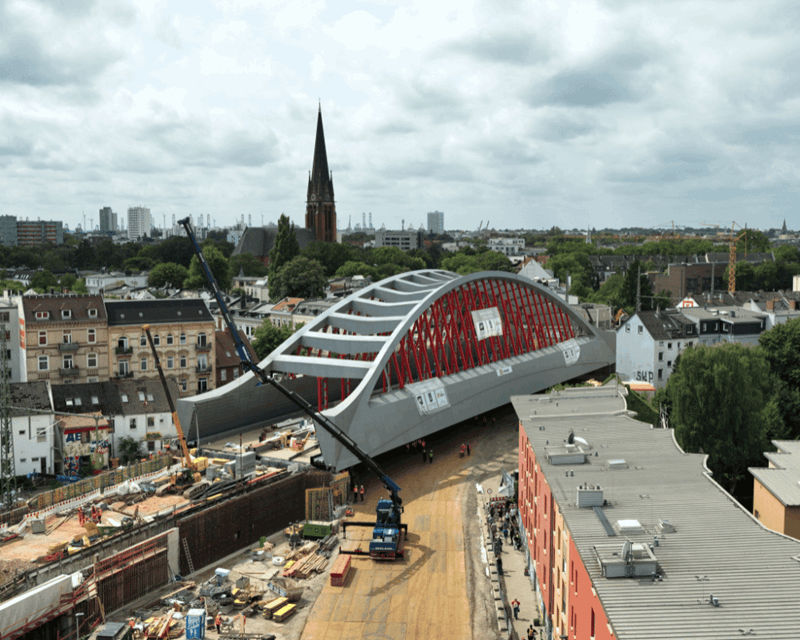
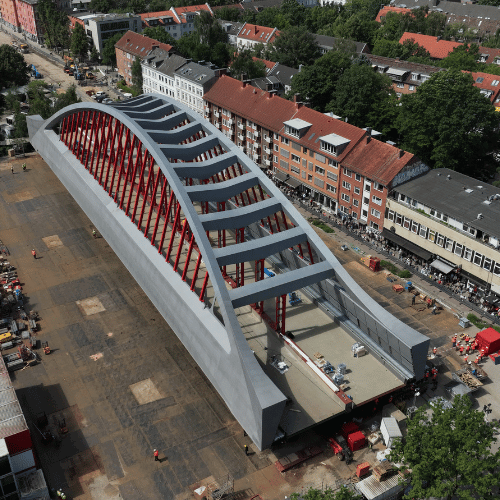
The 3,700t bridge was installed in one piece, minimising disruption in Germany’s second-largest city
There are different methods to launch a bridge. One particularly efficient method is to install the fully assembled bridge in one piece using a combination of specialized lifting and transport equipment.
When it comes to launches, the faster a bridge can be erected or replaced, the less disruption is caused to a city, traffic and its local communities.
When that bridge is in the heart of Germany’s second-largest city, however, achieving this becomes far more challenging, but not impossible.
Mammoet is an expert in Accelerated Bridge Construction (ABC) and was asked to consult on the feasibility of installing the new Sternbrücke bridge in Hamburg in one piece.
Based on the findings of its study, Mammoet proved that the transport and lifting were technically feasible and could be completed in under 24 hours.
Working closely with Deutsche Bahn as the project owner, and SEH Engineering GmbH as the general contractor and Mammoet’s client, Mammoet planned and executed the transport of the entire bridge from the pre-assembly area to its final position, with all activities taking place in Hamburg's densely built-up urban area.
The pre-assembly significantly shortened the on-site construction time, thereby reducing the disruption to the city and local communities.
Planning the road to success
The Sternbrücke is a prominent railway bridge in Hamburg, used by around 1,000 long-distance, regional and commuter trains every day. The bridge is also crossing two key roads, the Stresemannstraße and Max-Brauer-Allee, which serve tens of thousands of vehicles daily.
With the former Sternbrücke reaching end-of-service due to its age, and renovation not feasible, the decision was taken to replace the bridge with a new one instead.
In 2017, Mammoet was commissioned to carry out a feasibility study for installing the new Sternbrücke bridge in one piece using a transport solution.
“We determined that this was the only feasible way except for stick build,” explains Lars de Haas, Project Manager at Mammoet. “However, stick build was never really an option, as there are hundreds of trains a day that use the bridge, so they didn’t want to close it for several years”.
When the bridge design was revised, Mammoet determined the maximum width and height it could be for transporting on the Max-Brauer-Allee.
With the final revision of the study completed in 2023, Mammoet began putting its plan into action, ready for the eventual bridge launch in 2026.
“We visited the site and performed several 3D scans of the area and the full transportation route,” said Jamie Groeneweg, Lead Engineer at Mammoet. “By entering this data into our 3D engineering platform Move3D, we knew how narrow it was going to get and what space we had to work with. From there, we could plan accordingly”.
Just-in-Time approach for a tight work area
The bridge sections were brought to Hamburg and assembled in a laydown area beside the Max-Brauer-Allee within 14 months. The limited space in the dense urban environment added to the project's logistical complexity.
Mammoet was responsible for transporting the fully assembled bridge to its final position and for its final installation.
A particular challenge was the limited work area which was needed for both the assembly of the bridge sections and the mobilization of Mammoet’s transport equipment.
This meant a Just-in-Time approach was needed to bring everything to site in the correct order, and with the Max-Brauer-Allee used by around 30,000 cars per day, things were even more difficult.
“This was our biggest challenge: the logistics and organization of our equipment inside a very small area,” said de Haas. “Had we set up our trailers beside the bridge, it would have taken up all the space available and meant we wouldn’t have a laydown area. Anything arriving would immediately have to be assembled. There was a lot of work to ensure everything arrived just in time and in the correct order”.
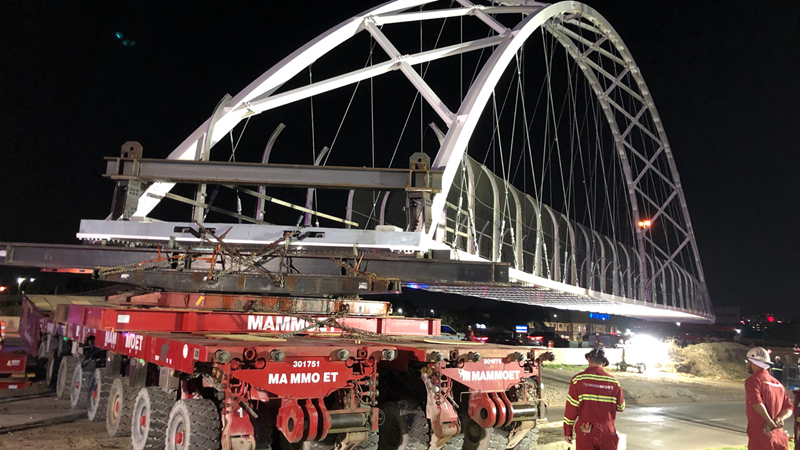
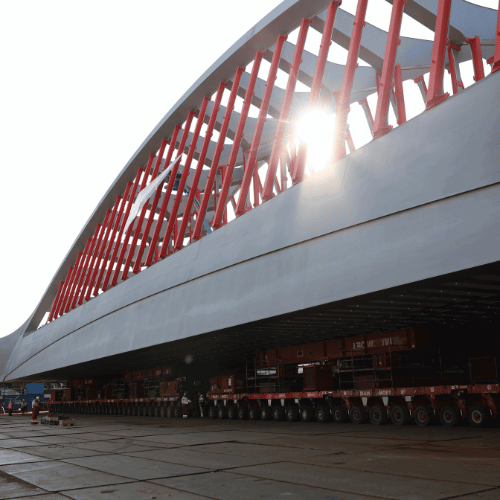
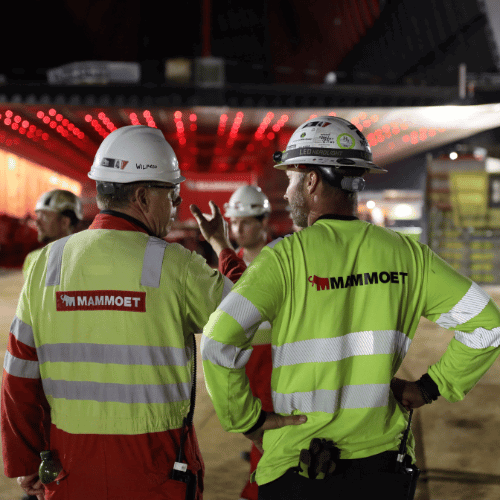
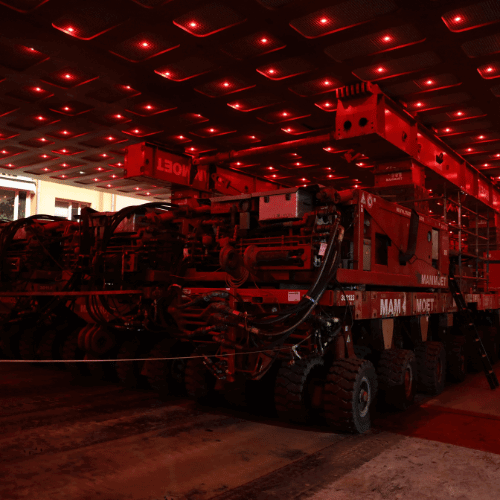
For the transportation of the bridge, two configurations of Mammoet Self-Propelled Modular Transporters (SPMTs), each consisting of four trains, with a combined total of 272 axle lines, were used, equipped with 16 x 500t climbing jacks to perform the lifts.
As space was so tight, the SPMTs were assembled in two stages. Once the first SPMT configuration was assembled using a mobile crane, the bridge was jacked up from 2 meters to 4.5 meters to allow the SPMTs to be positioned underneath.
The next SPMT configuration followed, and then, once all the SPMTs were in position and had taken over the full weight of the bridge, they were driven sideways onto the Max-Brauer-Allee.
The road, which had been specially prepared for the transport, allowed a second jack-up operation of another 1.5 meters, which was needed to clear the new abutments before the bridge could be lowered into its final position.
A special delivery for a special city
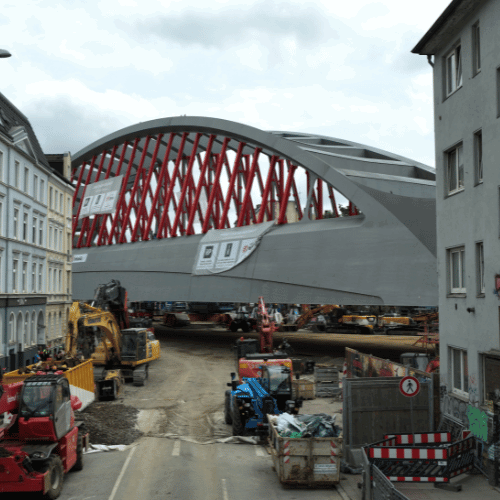
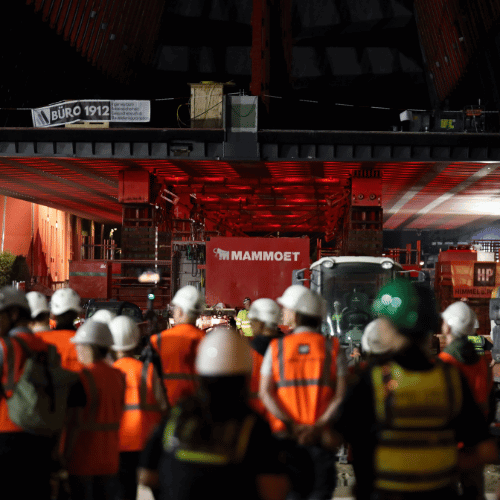
The bridge was driven 500 meters down the Max-Brauer-Allee to its final position, where it was turned 45-degrees using the SPMTs and then jacked down 1.8 meters.
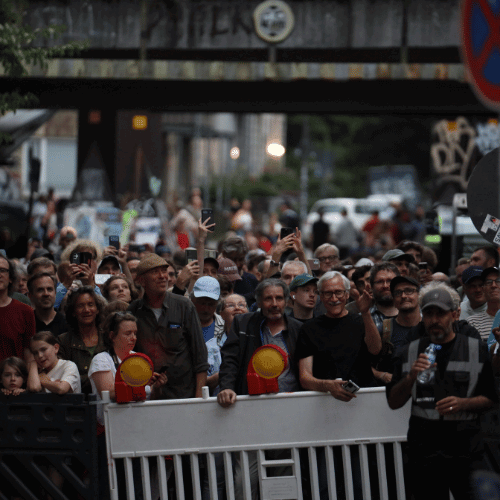
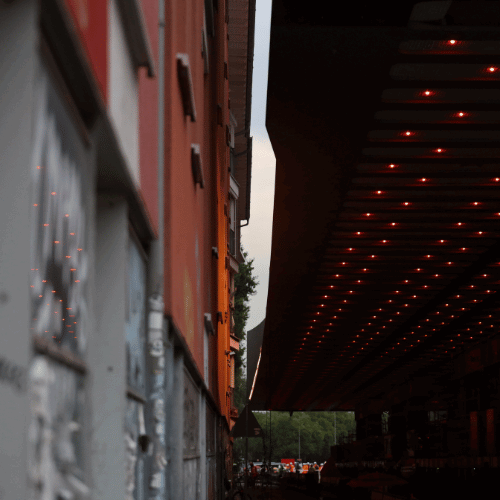
The space was extremely tight, with only 30cm on either side at the narrowest points along the transport route. And with the bridge filling the entire width of the Max-Brauer-Allee, the move attracted a lot of public and media interest.
The new Sternbrücke bridge reopened on 31 August 2026 after just six weeks of closure. Had the bridge been stick built, the result would have been years of disruption to the city.
With the space constraints, multidisciplinary nature of the project, and specialist equipment and technology needed, very few companies could have achieved this complex installation as a single provider.
“I’ve been working for Mammoet now for over 15 years and this is one of the highlights of my career,” adds Groeneweg. “It might not be the heaviest, nor the largest bridge we’ve moved, but it certainly had a big impact. So yes, for me, it was a special moment”.