Sector:
Case study
Nuclear Power
Expertise:
Heavy transport
Benefits:
Increased safety
Optimized schedule
Location:
Germany
Each steam generator had to be delivered within a specific time and offloaded in just two hours
As Germany phases out nuclear power, its power plants taken out of operation are being decommissioned and Mammoet is playing a key role in helping energy companies to do this safely and efficiently.
In 2024, Mammoet supported with the removal of four steam generators from PreussenElektra’s Nuclear Power Plant Unterweser in Germany.
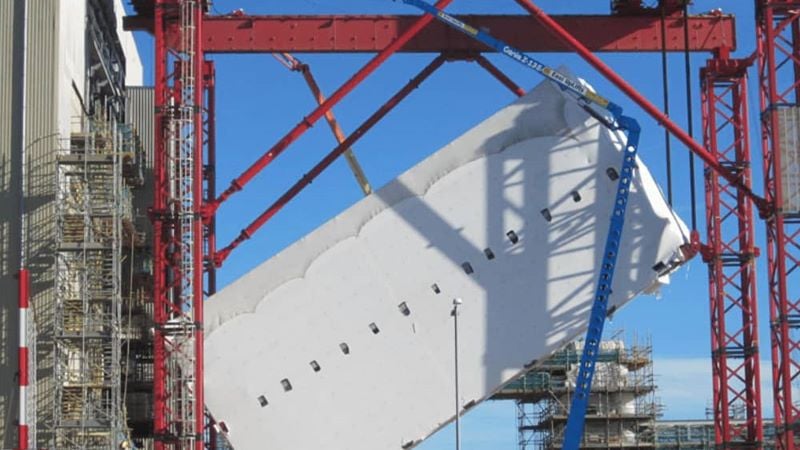
Its engineers provided a custom engineering solution to carefully remove them in one piece. This resulted in considerable time and cost savings, by preventing the need to have the major components dismantled inside the reactor building.
Recently, Mammoet returned to the power plant site to assist with the transport stage of this project on behalf of Orano NCS. The scope involved getting each steam generator from site to ship, so they could be sent to Cyclife’s specialized nuclear waste treatment facility in Sweden.
While this phase might sound straightforward, it was anything but – as a complex transport sequence had to be carefully planned and meticulously followed due to a combination of tidal and permit restrictions.
Overcoming a tide of challenges
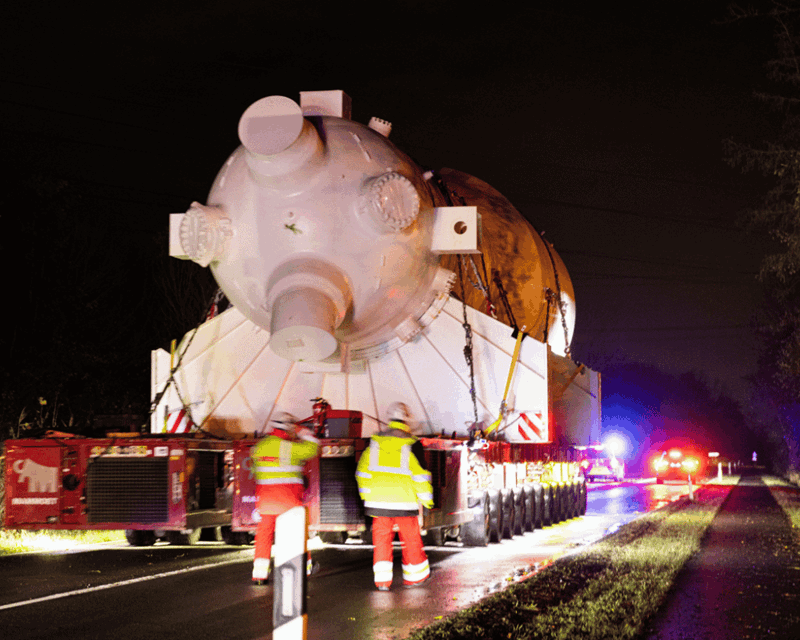
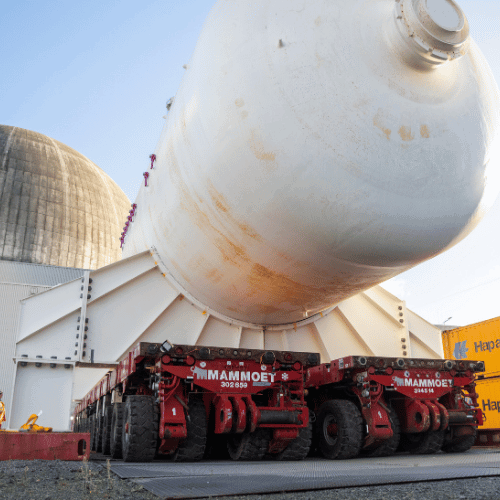
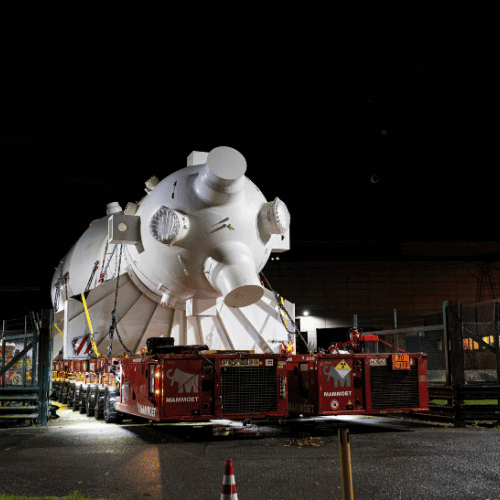
Following their removal from the reactor building, the steam generators awaited transport on the power plant premises. Each steam generator measured 20 meters long, 4.5 meters in diameter and weighed approximately 300t.
Originally, it was intended that a quay at the power plant would be used to load-out the steam generators onto the overseas vessel. However, after investigating this approach more closely, it was determined this would not be possible.
Due to the strong tides, the quay would need to be dredged, and this process would add considerable time and cost to the project.
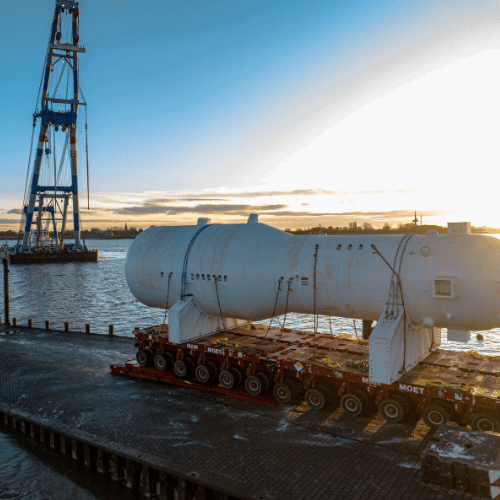
Instead, a ferry ramp, 5km away in the village of Kleinensiel, was identified as a possible solution. While the ferry service crossing the river Weser was no longer operating, the ramp remained and could serve as a perfect place for the load-outs.
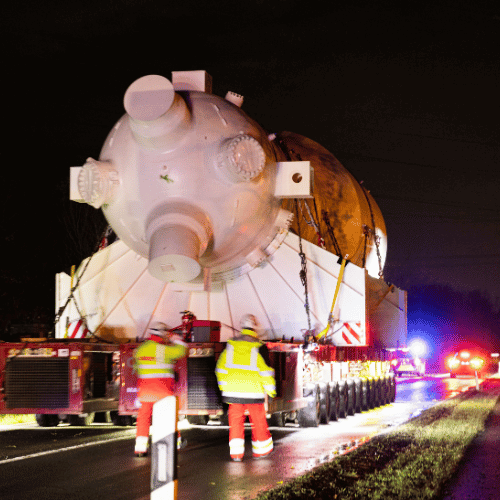
The challenge, however, was timing. The permit for the overland section of the route only permitted movements at night, from the hours 10pm to 6am in the morning. This was to minimize disruption to traffic using the public roads.
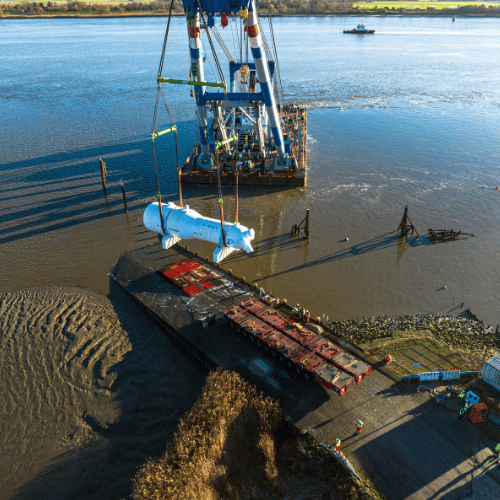
Each steam generator was transported on 2 x 12 axle lines of Self-Propelled Modular Transporters (SPMTs). Once at the ferry ramp, a floating sheerleg crane would then lift each large component off the SPMTs and sail it to an overseas vessel that was moored nearby. After each operation, the sheerleg crane and the overseas vessel returned to the harbor, located 100 meters away.
“The route was not so much the problem; we had enough space, but the situation on the ramp was a big challenge,” explains Tom Schladitz, Project Manager at Mammoet. “Because the river is close to the North Sea, you have very high tides that can reach up to three meters. As the water level rose, the ramp got smaller. It was a balance act because the tide had to be high enough so that the sheerleg crane could get close enough to the ramp, but we also had to mindful of the SPMTs not getting submerged in water.”
Determining the optimal position for the SPMTs to be on the ferry ramp was achieved by looking at future water level data. From this, the engineers established when the water would be at the best level to perform lifts and afford them the longest time window – this turned out to be just two hours, from 9am to 11am in the morning.
The ferry ramp itself also presented its own challenge. It had a downward slope towards the water of 4.2 degrees, which was too steep for the SPMTs to equalize, even with its jacks at full stroke. To solve this, and to ensure the center of gravity (COG) of the steam generators would not shift when lifted, an additional temporary ramp was constructed onto the existing ferry ramp to make the SPMT completely horizontal.
The overseas vessel collecting the steam generators could not set sail for the nuclear waste treatment facility in Sweden until all four steam generators were on board. For this reason, it was imperative that the executions were done over four nights to minimize the number of charter days for the overseas vessel and the floating sheerleg.
Two sets of SPMTs were used for the transports, and a parking area close to the ferry ramp served as a temporary laydown area to ensure all the stages and timings could be managed more easily.
On the first night, the first set of SPMTs, carrying a steam generator, would set off from the power plant at 10pm and then arrive at the parking area after the unloading operation in the following morning.
The second set of SPMTs would be loaded with the next steam generator during the day shift to be ready for transport in the next night shift.
After this steam generator arrived at the ferry ramp, the parked SPMT set would make its way from the parking area to the power plant so that it could be prepped for transporting the next steam generator.
This process would continue until each of the four steam generators was successfully transported.
Collaboration, timing, execution
Had just one steam generator failed to reach the load-out destination in time, or the subsequent two-hour offloading window been missed, an extra day would have been added to the schedule, resulting in significant downtime and cost to the project.
With time of the essence, careful planning and effective collaboration were crucial. Mammoet’s successful transport operations were the result of a joint effort by all parties involved: PreussenElektra (the site owner), Cyclife Sweden AB (as contract owner of the 2nd phase of the decommissioning project including transport ownership and operator of the treatment facility) and its subcontractors Orano NCS and Orano NPS (which organized the overseas transport with further subcontracting to Mammoet). Together, all parties ensured a safe and efficient outcome.
“I was very happy when the first steam generator was successfully lifted on the overseas vessel,” ends Schladitz, “as it was clear that our sequence worked. We planned this transport for over a year, so it was incredible to see all that preparation pay off and us deliver another successful project for our client.”