
Sector:
Civil Engineering
Expertise:
Heavy transport
Benefits:
Parallel operations
Reduced disruption
Location:
United States
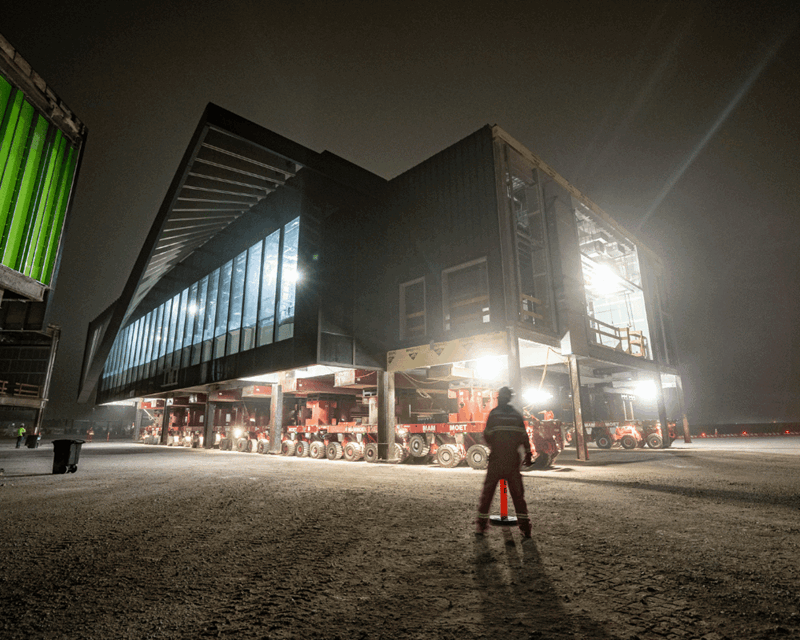
The segments were built off-site and delivered to the airport to minimize disruption.
Mammoet is firmly establishing itself as the industry leader when it comes to efficient airport expansions using modular construction techniques, having delivered successful projects at Atlanta, Portland and Dallas airports.
The process – which involves prefabricating large structures off-site, in segments, and then delivering them to the job site for assembly – is perfect for busy sites like airports.
Managing movements in the air and on the ground, and welcoming hundreds of thousands of visitors per day, airports are bustling places with tight security and safety protocols.
Moreover, using valuable runway space and closing terminals to accommodate civil projects can have a significant impact on daily operations of an airport and the passenger experience.
Working under W.E. O’Neil Construction, Mammoet was a trusted partner for the Midfield Satellite Concourse (MSC) South project – a 13,500 square meter (146,000-square-foot) concourse to increase passenger efficiency at LAX airport.
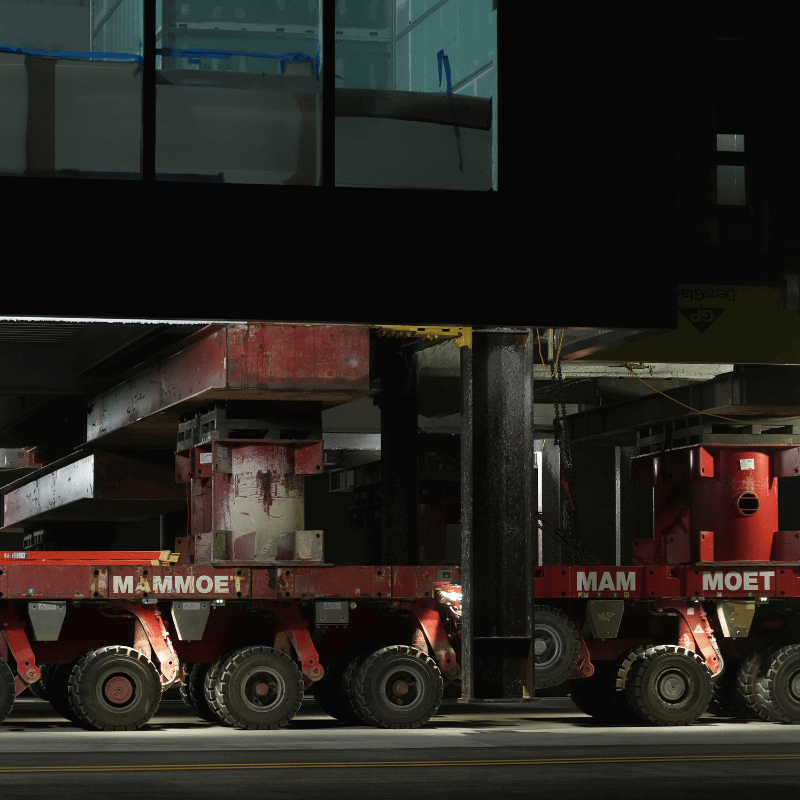
Mammoet delivered the nine segments of the concourse to site, supporting a fabrication-to-foundation solution that limited disruption and enabled installation to complete in just three weeks.
Fabrication, falsework, foundation
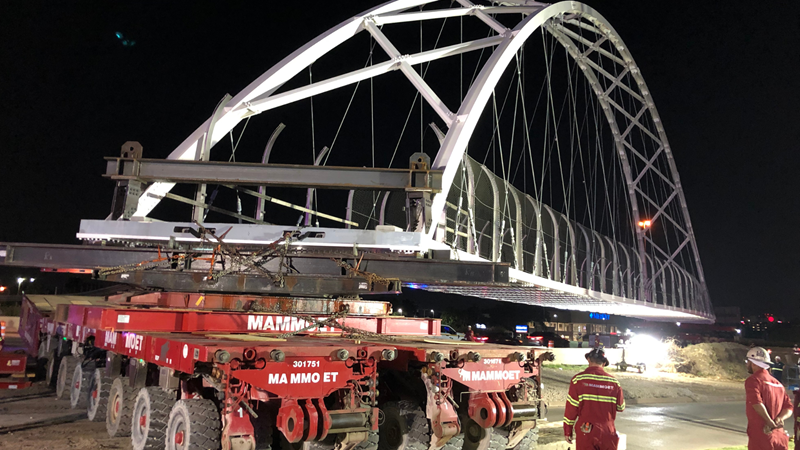
Mammoet worked with the customer to ensure that each segment could be transported safely using Mammoet Self-Propelled Modular Transporters (SPMTs).
Different configurations of between 36 to 60 axle lines of SPMT were used to move the units, which ranged in weight from 430 to 950 tonnes.
The segments were far along in terms of their build, with some even containing tiles and bathroom fixtures. Entering at this late stage presented a challenge for the team.
“The segments were around 80% turnkey ready when we had to deliver them to the site,” explains Reid Whitley, Senior Project Manager at Mammoet. “This created a unique challenge when it came to building up the falseworks.
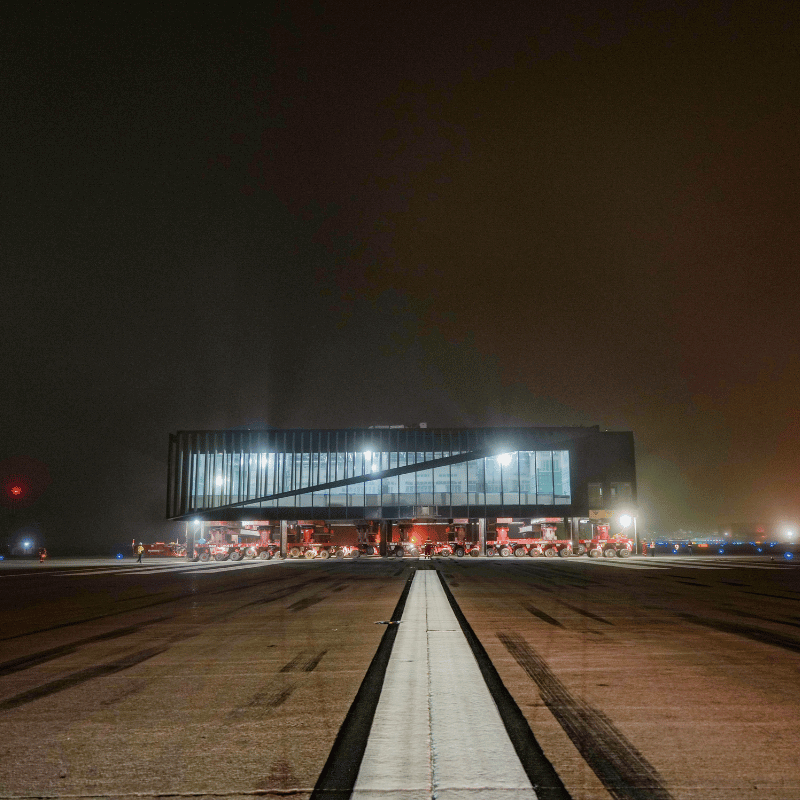
Normally, the falsework is fitted to the transporter, which is then driven underneath the module. In the case of LAX, we did it backwards. We positioned the SPMTs under the segments first and then stacked the beams at different angles based on the location of the support columns”.
This unusual, but necessary, falsework approach naturally added time. To offset this and ensure that the schedule was still met, Mammoet had a day and night team working around the clock.
It was the day team’s responsibility to build up the falseworks and get the segments onto the SPMTs. The night team would then take over, transporting them to the site before returning the trailers to the yard ready for the next segment.
LAX airport is close to a beach, and this created visibility challenges for the night team. In October, the warm days and cold nights produced a thick blanket of fog in the early hours. With visibility often less than 45 meters (150 feet), radio communications became vital.
There were other challenges too, such as ensuring the SPMT power packs met California emissions laws and didn’t interfere with the seismic tracking equipment used to monitor the risk of potential earthquakes.
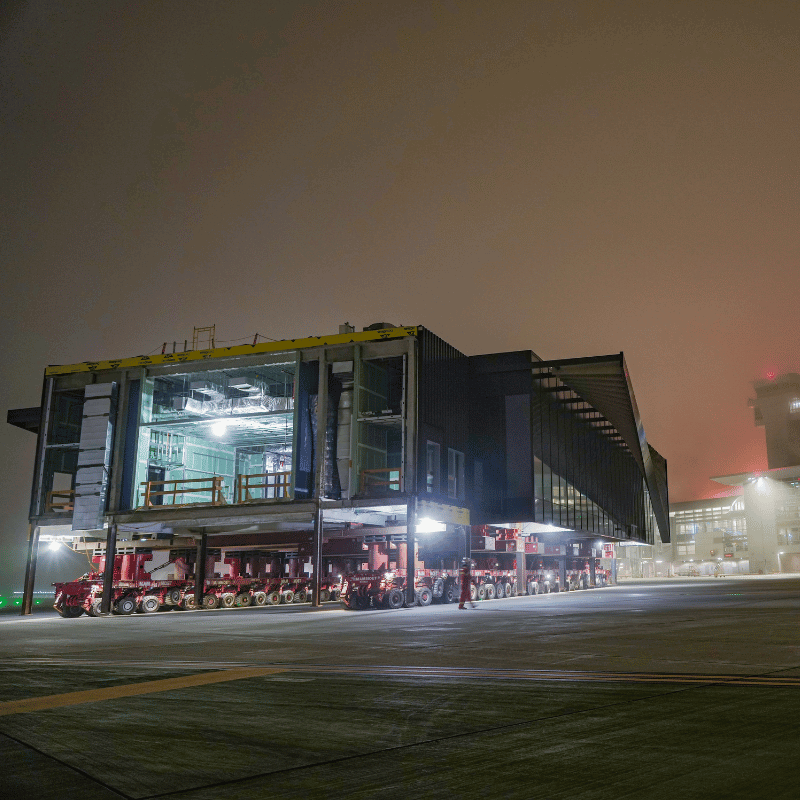
The client also built a temporary earthen bridge over a drainage system close to the fabrication yard. Measuring 30 meters (100 feet) in length and nearly 25 meters (80 feet) in depth, crossing it was also a concern.
To ensure everything was structurally sound ahead of the operation, the team arrived two weeks early to perform a test lift; checking the falsework solution and rolling everything over the bridge.
Specialists in first-class airport construction
Airports are understandably risk averse and prefer that civil work be performed in a way that creates the least amount of disruption to passengers.
Modular construction is a great way to prevent airports from becoming construction sites by reducing the amount of equipment and operators required at the final location.
It also allows component parts to be built more efficiently and in parallel. Ultimately, this results in less disruption and happier customers.
“While the execution seems rather simple, a lot of planning and work happens behind the scenes to ensure a site is fully prepared,” closes Whitley.
“That’s the thing that separates Mammoet from others in airport construction – the engineers designing and developing these plans and the skilled operators executing them”.
Installation of the concourse took just under one month. It was completed on 1 November 2024, leaving more than a year for additional work to be completed so it could be ready for its grand opening.